


Reorgs rarely fail because the strategy is wrong — they fail because organizational memory is stronger than what a new structure can repair. When past restructurings, broken promises, and power imbalances are never fully resolved, they harden into cultural patterns that silently shape how people collaborate and respond to every new change. Leaders announce fresh operating models, but employees navigate through stories, scars, and unwritten rules that outlive any org chart.
This article reframes failed transformations not as resistance or poor execution, but as the predictable consequence of unresolved history. It explores how cultural “ghosts” form, why they intensify during reorgs, and how they shape expectations, trust, and behavior long after official structures shift. Drawing on research in organizational memory, path dependence, and change readiness, it highlights where leaders underestimate the past, where evidence remains thin, and what organizations must redesign — not in structure, but in narrative and meaning-making — if they want change to become real rather than repeated.
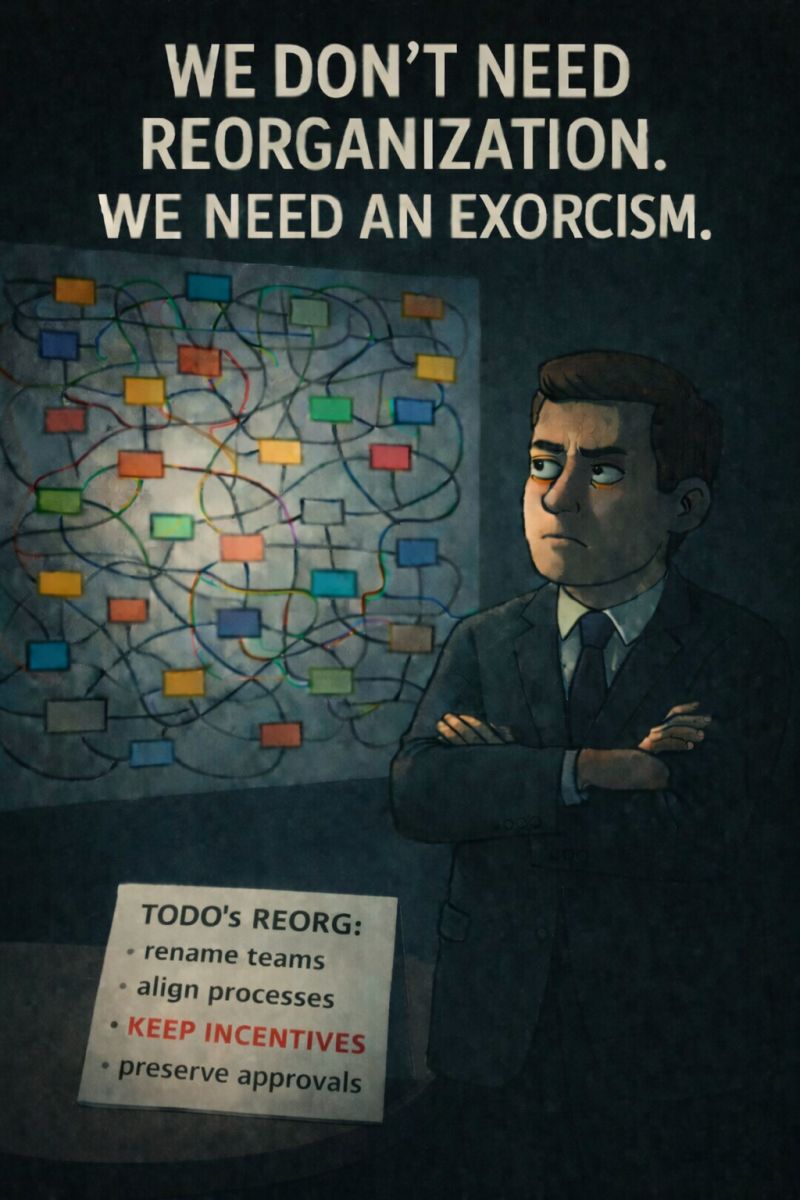
Reorgs can redraw the org chart — but they can’t erase what people remember.
Executives love the promise of a clean slate. A new structure, a new operating model, a new leadership layer — and with it, the hope that old conflicts, politics, and unproductive habits will finally disappear. For a few months, energy spikes. People learn new reporting lines, attend new ceremonies, repeat new slogans.
And then, almost inevitably, the old culture seeps back through the cracks. The same turf battles, the same avoidance of conflict, the same quiet cynicism in corridor conversations. Different structure, familiar feeling. It’s tempting to label this “resistance to change.” But that’s too superficial. The deeper truth is harsher: reorgs can redraw formal power, but they don’t erase collective memory. And what people remember about how this place really works will always beat what’s drawn on paper.
What Leaders Think a Reorg Does — And What It Actually Does
Most executive teams approach restructuring as a rational design problem: strategy has shifted, so we must realign structure, decision rights, and incentives — and if we execute well, behavior will follow. The implicit model is architectural: fix the blueprint, and the building will function differently.
But organizations don’t behave like buildings. They behave more like old houses: full of stories, unexplained noises, rooms nobody uses anymore, and corners where people instinctively lower their voice. Decades of change research suggest that a large share of major transformation efforts either fail outright or don’t deliver their intended benefits (Kotter, 1995; Hughes, 2011). The exact “70% fail” number is debatable — the pattern isn’t: structural change is far easier to announce than to embed.
While leaders are busy moving boxes, the organization is busy making sense of what those moves really mean — using the only raw material it has: its history. A reorg does change something real: it alters roles, reporting lines, and access to information. But it also does something leaders underestimate: it reactivates old memories of previous restructurings, layoffs, integrations, and “strategic resets”. Those memories are the raw material from which cultural ghosts are made.
What Is a “Cultural Ghost”?
A cultural ghost is not a mystical idea. It is shorthand for the enduring influence of unresolved past events on present behavior. It’s what happens when a charged episode, a lack of processing, and a surviving story combine into something that keeps shaping how people think, feel, and act.
Three elements typically converge:
- A charged episode: a painful restructuring, a merger, a scandal, a harsh leadership regime, or even a mythologized “golden age”.
- A lack of collective processing: no real acknowledgment, no space to grieve or reflect, no genuine learning — just “moving on” and “staying positive”.
- A surviving story: “You can’t trust announcements here”, “In the end, headquarters always wins”, “Speaking up is career suicide”, “Our best years ended when that division was shut down”.
Organizational memory research shows that such stories rarely fade on their own; they become part of how people anticipate the future and explain the present (Coraiola & Derry, 2017). In that sense, cultural ghosts are cognitive (they shape expectations), emotional (they carry unresolved fear, grief, anger, or nostalgia), and relational (they cluster in teams, professions, and locations that shared a particular experience).
You can’t see them on an org chart. But you can feel them when a harmless announcement triggers disproportionate anxiety, when a new leader inherits distrust they did not personally earn, or when a “fresh start” narrative is met with polite silence and knowing looks.
Why Reorgs Often Make Ghosts Stronger, Not Weaker
Ironically, the very act of restructuring can intensify the haunting. Three mechanisms appear in transformation after transformation: narrative vacuums, suppressed remembering, and symbolic betrayal.
Narrative vacuum. Reorgs are usually over-explained in business logic and under-explained in human logic. Leaders invest in synergy rationales and operating-model diagrams — and give only a few sentences to what people actually care about: “What does this mean for us, given our history?”, “How is this different from the last three ‘transformations’?”, “Why should we believe this won’t end the same way?” When this human narrative is missing, people fill the gap with old stories. Those stories are almost never flattering.
Suppressed remembering. In many organizations, there’s an unspoken rule: don’t dwell on the past, be positive, support the change. The intention is to avoid blame. The effect is that the official story stays clean, while the unofficial story goes underground and becomes more emotionally charged. Instead of healthy forgetting, the organization develops haunted forgetting: the past returns in symptoms rather than in conversation.
Symbolic betrayal. Cultural ghosts feed on contradictions between words and actions. If leadership says “this reorg is about empowering teams”, but decision rights remain centralized, budgets stay opaque, or the same inner circle keeps all real power, then the ghost — “nothing really changes here” — grows stronger. People learn, once again, that it’s safer to trust history than announcements.
Anatomy of a Haunted Organization
- Echo reactions: New initiatives trigger old references — “This feels exactly like the 2016 restructuring.” People aren’t evaluating the present; they’re reliving the past.
- Inherited distrust: New leaders face skepticism not because of what they’ve done, but because their role or function evokes earlier regimes.
- Frozen middle: Middle managers nod along in town halls, then quietly buffer their teams: “We’ll wait and see if this really sticks.” They protect their people from over-investing in a change they expect leadership to abandon.
- Phantom constraints: People insist, “We’re not allowed to do that,” about practices no longer formally forbidden — but which were punished years ago.
In haunted organizations, history is strangely absent from official narratives — timelines celebrate only successes — while employees share a rich underground history over coffee, chat, and late-night emails. What looks like resistance is, in many cases, a rational response to remembered experience.
Why the Promise of a Clean Slate Feels So Attractive
Reorgs offer leaders something deeply seductive: the sense of control. When strategy is unclear or markets are volatile, it is easier to redraw structures than to sit with ambiguity. A new design feels like decisive action. It turns a messy, human problem into a solvable diagram.
But this control reflex has a hidden cost. By treating culture as something that can be reset rather than remembered, leaders inadvertently invalidate people’s experiences. When past pain, broken promises, or unfairness are never named, employees conclude that leadership either didn’t notice or didn’t care. Trust erodes quietly. Future changes are heard through a filter of skepticism: “We’ve seen this movie before.”
A Thread to Validity: What the Evidence Says — and Where It Fails
Research doesn’t talk about “ghosts”, but it does document the mechanisms behind them. Scholars of organizational memory and change highlight three relevant strands:
- Studies on organizational memory show how stories, routines, and artifacts preserve interpretations of past events and continue shaping current decisions long after structures change (Walsh & Ungson, 1991; Schultz & Hernes, 2013).
- Research on path dependence demonstrates how earlier decisions continue to constrain present options, even when leaders formally remove old structures or rules (Sydow, Schreyögg & Koch, 2009).
- Classic change research documents high failure rates and recurring patterns of “initiative fatigue,” where employees disengage after too many broken change promises (Kotter, 1995; Hughes, 2011).
At the same time, we lack large-scale, longitudinal models that fully integrate structure, memory, and emotion. The field has rich case studies and conceptual frameworks, but few predictive tools. That gap matters: without such models, organizations over-generalize, assuming that rearranging structure will automatically rearrange culture — and are then surprised when the old patterns quietly return.
Recognizing the Signs of a Haunted Organization
- Do people reference past restructurings more than they discuss the current one?
- Do new leaders inherit distrust they never personally earned?
- Do middle managers act as shock absorbers, quietly slowing or buffering every change?
- Do “unwritten rules” from years ago still govern what people feel is possible?
“Reorgs can shift boxes and titles — but until leaders work with the organization’s memories, the cultural ghost simply won’t leave.”
The Case for Working With Ghosts, Not Against Them
The goal is not to eliminate the past; that’s impossible. The goal is to integrate it. Leaders who treat cultural ghosts as information, not as enemies, gain access to a hidden map of how change is really experienced in their organization. Instead of asking, “How do we push this design through?”, they ask, “What has history taught people to expect from us — and how do we behave differently this time?”
That requires humility and patience. It means acknowledging missteps in prior changes, surfacing stories that make leaders uncomfortable, and accepting that trust is not built by structure, but by repeated, observable contradictions of the old story.
How to Rethink Reorgs as Cultural Work
- Start with history, not boxes: Before presenting a new design, invite people to name what past changes felt like, what hurt, what helped, and what patterns they fear repeating.
- Name the ghosts: Say out loud what people say in private — for example, “We know that previous restructurings often meant cuts without real improvement.”
- Design visible breaks with the past: Choose a few symbolic decisions (promotions, handling of failure, allocation of power) that clearly contradict the old culture and talk openly about why you’re doing them.
- Create ongoing sensemaking rituals: Establish regular forums where teams can discuss what feels genuinely new, what feels like recurrence, and where trust is growing or shrinking.
Conclusion
Seeing your organization as “haunted” is not about dramatizing it. It is about taking seriously that change efforts always land in a landscape shaped by previous changes — and that people are not resisting your strategy; they are protecting themselves from their history. Reorgs can be necessary, smart, and unavoidable. But they are never neutral. They awaken what came before.
Until leaders learn to work with those ghosts — to listen to them, learn from them, and deliberately contradict the stories that keep them alive — no structure will hold for long. The boxes will move. The patterns will stay.
Structures can be changed in a quarter. Cultural ghosts leave only when the story of the organization is rewritten.
- Kotter, J. P. (1995). Leading Change: Why Transformation Efforts Fail. Harvard Business Review. URL: https://hbr.org/1995/05/leading-change-why-transformation-efforts-fail-2
- Hughes, M. (2011). Do 70% of All Organizational Change Initiatives Really Fail? Journal of Change Management, 11(4), 451–464. DOI: 10.1080/14697017.2011.630506
- Weick, K. E. (1995). Sensemaking in Organizations. Thousand Oaks, CA: SAGE Publications. URL: https://us.sagepub.com/en-us/nam/sensemaking-in-organizations/book4988
- Walsh, J. P.; & Ungson, G. R. (1991). Organizational Memory. Academy of Management Review, 16(1), 57–91. DOI: 10.5465/amr.1991.4278992
- Schultz, M.; & Hernes, T. (2013). A Temporal Perspective on Organizational Identity. Organization Science, 24(1), 1–21. DOI: 10.1287/orsc.1110.0731
- Dutton, J. E.; & Dukerich, J. M. (1991). Keeping an Eye on the Mirror: Image and Identity in Organizational Adaptation. Academy of Management Journal, 34(3), 517–554. DOI: 10.2307/256405. URL: https://www.researchgate.net/publication/248747897_Keeping_an_Eye_on_the_Mirror_Image_and_Identity_in_Organizational_Adaptation
- Sydow, J.; Schreyögg, G.; & Koch, J. (2009). Organizational Path Dependence: Opening the Black Box. Academy of Management Review, 34(4), 689–709. DOI: 10.5465/amr.34.4.zok689
- Huy, Q. N. (1999). Emotional Capability, Emotional Intelligence, and Radical Change. Academy of Management Review, 24(2), 325–345. URL: https://www.jstor.org/stable/259085
- Feldman, M. S.; & Pentland, B. T. (2003). Reconceptualizing Organizational Routines as a Source of Flexibility and Change. Administrative Science Quarterly, 48(1), 94–118. DOI: 10.2307/3556620
- Tsoukas, H.; & Chia, R. (2002). On Organizational Becoming: Rethinking Organizational Change. Organization Science, 13(5), 567–582. DOI: 10.1287/orsc.13.5.567.7810